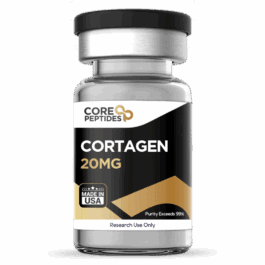
Cortagen – 20MG
$59.00
Cortagen is the tetrapeptide Ala-Glu-Asp-Pro, designed from the cortexin polypeptide complex. Content size is 20mg, in the form of lyophilized powder. Peptides are sold for laboratory research use only.
Purity: 99%+ by HPLC (third-party tested)
Tested by: Vanguard Laboratory, see Certificate of Analysis
SKU: P-Cortagen
What Is Cortagen?
Cortagen is posited to be a synthetic tetrapeptide with the sequence Ala–Glu–Asp–Pro, originally designed based on amino acid analysis of the polypeptide complex cortexin. It is classified among the so-called Khavinson peptides – a family of short peptide bioregulators that are proposed to modulate endogenous regulatory systems rather than acting as classical receptor agonists or enzyme inhibitors.(1) These are low-molecular-weight peptides that are posited to be able to penetrate cells and reach the nucleus, where they may interact directly with DNA and chromatin structures in mammalian research models.
Currently, the peptide is under investigation in laboratory settings for its potential to support stress signaling in different cell cultures, including nerve cell circuits.
Specifications
| Name | Cortagen |
| Other known names | AEDP, Ala-Glu-Asp-Pro |
| Sequence | Ala-Glu-Asp-Pro (4 amino acids) |
| Molecular formula | C17H26N4O9 |
| Molecular weight | 430.4 g/mol |
| Synthesis | Solid-phase peptide synthesis, US |
| Form | Lyophilized powder |
| Amount per vial | 20 mg |
| Purity | >99% (HPLC) |
| Storage | −20 °C, dry, protected from light |
| SKU | P-Cortagen |
What Does Research Show About Cortagen?
How May Cortagen Affect Chromatin?
Research by Lezhava et al. suggests that Cortagen may have epigenetic support for aged cells, potentially restoring the expression of genes suppressed by the aging process of the cell via decondensation of the chromatin.(2) According to the researchers, Cortagen was applied to lymphoid cell cultures exhibiting an aged chromatin profile to assess its potential. Differential scanning calorimetry suggested that chromatin was thermodynamically less stable and therefore more uncondensed following Cortagen experimentation.
These study authors proposed that Cortagen may partially unfold higher-order chromatin structures, such as loops of 30-nm fibers and even 10-nm nucleosomal filaments into more relaxed 5-nm fibers, implying that the “peptidebioregulator Cortagen induces unrolling deheterochromatinization (decondensation) of total heterochromatin”(2) in both structural and facultative chromatin domains. Consequently, ribosomal gene clusters may become more transcriptionally active, potentially supporting protein synthesis capacity in these aged cells. Yet, Cortagen does not appear to remodel all constitutive blocks as pericentromeric C-heterochromatin on chromosomes analogous to 1, 9, and 16 remained structurally stable. Cortagen also appeared to increase sister chromatid exchange (SCE) frequency in some chromosome groups, which the authors viewed as a potential cytogenetic marker of facultative heterochromatin decondensation and possible re-release of previously repressed genes.
How May Cortagen Affect Oxidative Stress?
Key finding: In rats, exposure to Cortagen lowered lipid peroxidation products and oxidative modification of proteins in serum and the cerebral cortex.(3)
According to the research of Kozina et al., Cortagen may support lipid peroxidation and oxidative modification of proteins in rats.(3) According to the team of scientists, Cortagen exposure was associated with “decreased the content of LPO products and reduced oxidative modification of proteins” in the cerebral cortex. In the cells, the peptide also tended to lower later-stage products. In parallel, Cortagen appeared to reduce the accumulation of protein carbonyl groups, which act as markers of oxidative protein modification, and appeared to achieve a significant reduction in neural cells, and by about 15% in the extracellular fraction.
These authors suggested that Cortagen may interfere with the chain of reactions whereby reactive lipid species attack amino groups in proteins, possibly limiting downstream carbonyl formation. Yet, Cortagen’s potential was apparent only in integrated biological models, suggesting that it may not act as a simple radical scavenger, but instead possibly modulates the generation of reactive species upstream, or alters how cells handle oxidative stress. Thus, the researchers suggest that Cortagen may exert an indirect antioxidant-like action in neural systems by dampening lipid and protein oxidation.
How May Cortagen Affect Gene Expression and Differentiation?
Key finding: In the hearts of mice given Cortagen for 5 days, 234 of 15,247 transcripts (110 known genes) changed significantly, with up to 5.42-fold up-regulation.(4)
Studies involving a transcriptome-wide analysis of Cortagen’s potential in the hearts of mice, suggest that the peptide may support the cellular stress response. Specifically, Anisimov et al. suggested that Cortagen may modulate genes related to carrier proteins and membrane transport, as well as DNA synthesis and replication involved in that response.(4) This pattern of changes is interpreted as potentially supporting intracellular transport processes and proliferative or reparative programs at the transcriptional level.
Cortagen also apparently up-regulated several mitochondrial genes (16S rRNA, COX3, ND5), which may theoretically interact with bioenergetics. In parallel, transcripts linked to ionic homeostasis and Ca²⁺ handling were altered, hinting at a possible support for excitation–contraction coupling pathways. Among particularly notable targets, Cortagen increased expression of stress-response genes (Pass1, Hsc70), developmental and survival-related signals (Bmp2, Wnt4), and components of mitogenic or survival signaling (Eps15, Eps15-rs). The authors posit that these coordinated transcriptional shifts may underlie some of Cortagen’s broader biological actions and suggest that the peptide may serve as a helpful laboratory tool for exploring peptide-mediated regulation of stress-response networks in mice.
Further research by Khavinson et al. suggested that by modifying gene expression, the peptide may also support cellular differentiation.(5) Experimentally, the authors examined Cortagen in an in vitro model using pluripotent embryonic ectodermal tissue. Ectodermal explants were incubated for 1 hour in solutions of Cortagen and then cultured. In the reference medium without peptides, the pluripotent ectoderm apparently gave rise only to atypical epidermis. By contrast, exposure to Cortagen induced the same pluripotent cells to differentiate into epidermal and mesenchymal cells, suggesting that these peptides may broaden the available differentiation pathways.
What Was Studied in Nerve Regeneration?
Key finding: In rats with a transected and sutured sciatic nerve, 10 days of Cortagen increased the growth rate of the regenerating nerve fibers by 27% and their conduction velocity by 40%.(7)
Cortagen has been examined in laboratory studies by Adriani et al., who have been investigating the activation of arousal- and stress-linked circuits through global output patterns. The scientists observed that the peptide apparently may support output from neural networks associated with arousal and exploratory drive, without concurrently amplifying stress-linked appraisal signals. This pattern may reflect a state in which outward-oriented processing dominates over internal “risk-checking” loops, suggesting a shift in the balance of stress-signaling within the network.(6)
The potential implications of Cortagen on nerve regeneration may better support these observations. A group of researchers, led by Turchaninova et. al., investigated the neuroregenerative potential of Cortagen. The scientists transected sciatic nerve trunks, which were then micro-sutured and studied in vitro on a multielectrode platform. Compound action potentials (CAPs) were recorded on the isolated nerves at defined distances distal to the suture line.
Cortagen apparently increased the length of the nerve segment able to conduct impulses by 27% and better-supported conduction velocity by 40% compared to placebo. The authors also suggested that the peptide may preferentially support regeneration where baseline growth is lower, rather than extending growth beyond the usual maximal range. This faster conduction is interpreted as a potential marker of more advanced functional maturation, possibly involving better-supported myelination and fiber calibre.
Certificate of Analysis
| Batch / lot | C83647 |
| Test date | 4/2/2026 |
| Testing laboratory | Vanguard Laboratory |
| Accreditation | A2LA Certificate #6377.01.01 |
| Method | HPLC-UV/VIS (purity) |
| Purity result | >99.80% |
| Full report | Download the Cortagen COA (PDF) |
Cortagen peptide is available for research and laboratory purposes only. We offer free shipping in the US for orders over $200. Please review our Terms and Conditions before ordering.
Related products
ARA-290 – 16MG